


9. Ammunition Depot in the Segeberg Forest
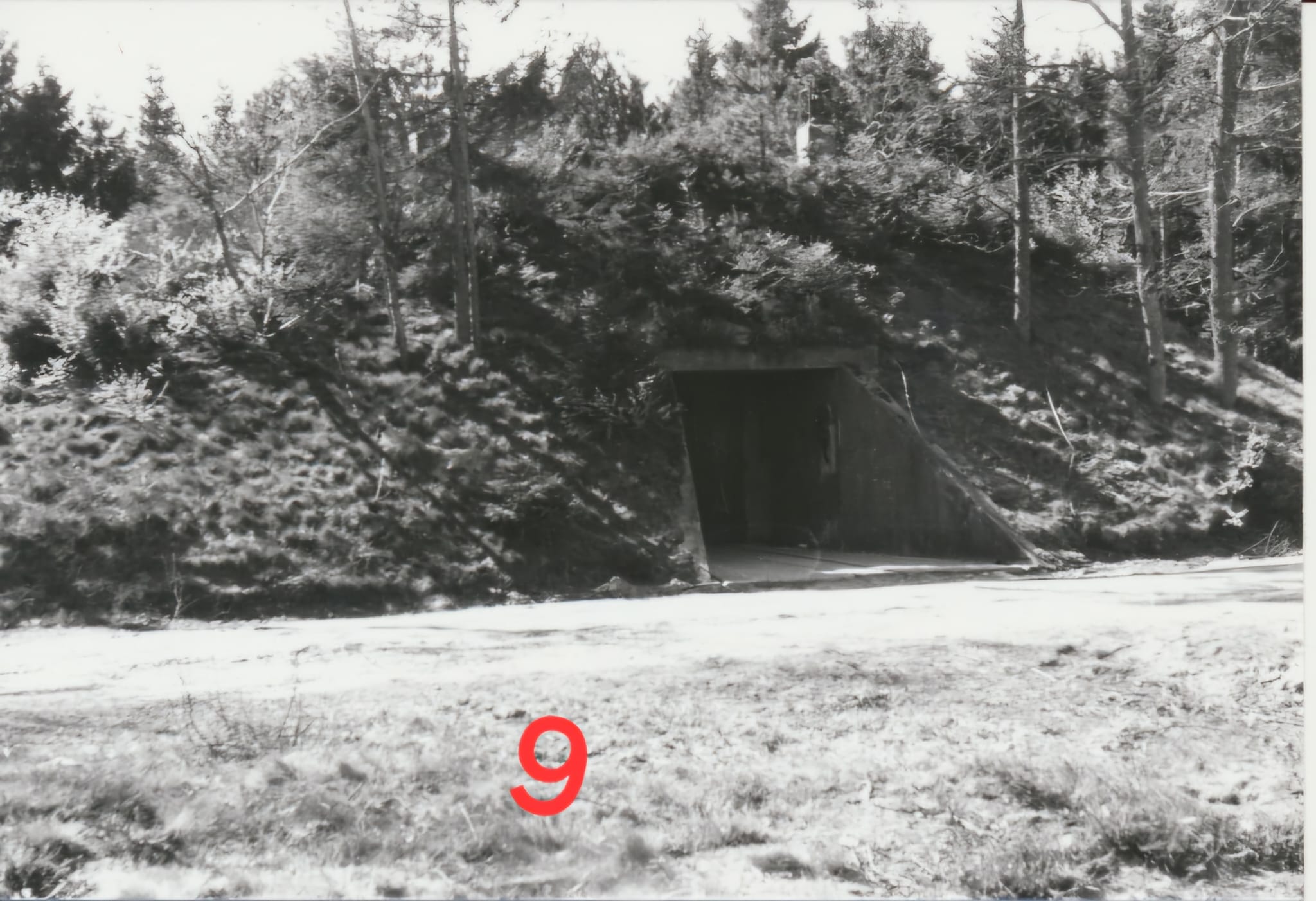
The ammunition depot in the Segeberg Forest
Use of the facilities from 1939 to 1945
For reasons of camouflage, the 225 bunkers, officially called “ammunition houses,”
were built underground in the Segeberg Forest. Groups of trees with thick canopies ensured that the ammunition houses were shaded and concealed.
In order to ensure that the ammunition was stored in completely dry conditions, the bunkers were only partially sunk into the ground.
The outer walls of the bunkers were 1.50 m thick at the base and tapered to 80 cm at the ceiling. The freely
supported ceiling had a load-bearing capacity of 1200 kg/sqm.
Some of the ammunition depots were equipped with hand-operated cranes. The entrance was protected against shrapnel by an armored door and against heat loss by a heat-insulated door.
Lighting was provided by direct cable connection or by portable diesel-powered generators. It was connected to the narrow-gauge railway network of thearsenal, and trains could enter the bunkers.
1945–1949 Demilitarization and arsenal dismantling
After the war, as part of the arsenal dismantling, a total of 47.390 tons of ammunition
was destroyed, with 6.177 tons of powder burned between July 7, 1945 and November 7,
1947, 11.688 tons were delivered to the Allied victorious powers, 4.309 tons were used for blasting
(including on Helgoland), and 23.455 tons, almost half of the stockpile, were sunk off in Kiel in the Baltic Sea, where they still lie today...
With the completion of all liquidation work, the inventory of the Fahrenkrug Naval Artillery
Arsenal officially ended on December 6 in 1947.
However, between March 30 and April 19, 1948, 170 bunkers were blown up, followed by the remaining ones on May 16, 1949 – except for seven: the four at the so-called “Knüppeldamm” (today: Willy-Pelz-Straße/Alter Barker Weg), in which the British military government still stored 163 tons of ammunition, and three at Gate 8.
Use from 1949
In 1952, a so-called land exchange agreement transferred ownership of the bunker site back
to the forestry administration, while the “rest” of the arsenal site, including the buildings, became the property of the tax authorities and part of the municipality of Wahlstedt.
The four bunkers on “Knüppeldamm” were used in the past by Wahlstedt companies and the THW (Federal Agency for Technical Relief) and are now rented by private individuals, while the three other bunkers were temporarily rented by a demolition company and are now used by Nabu as a bat roost.
The former arsenal site located south of what later became Willy-Pelz-Str. / west of Kronsheider Straße was cleared of the bunker ruins, sold, and has been largely occupied by the Grundfos pump factory since 1960 and later by Pelz-Watte with its high-bay warehouse.
Current status in 2025
- The remaining bunkers are used by private tenants and Nabu.
- The part of the bunker site that has been converted into commercial space is used by
Grundfos and Pelz for their industrial buildings.
- However, most of the former arsenal site now belongs to the Segeberg
Forest.