


11. Warehouse Operations
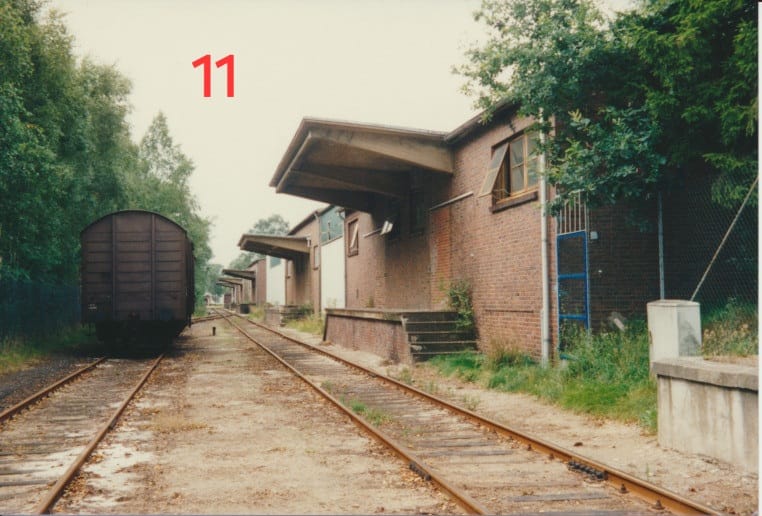
Warehouse operations
Use of the facilities from 1939 to 1945
The arsenal's warehouse operations were divided into
- general warehouse operations for internal use
These included: the silk cloth warehouse, the consumables warehouse, the
special consumables warehouse, the oil and paint cellar, the waste warehouse, and the
waste paper collection
- and the ammunition storage operation, which was in turn divided into
-the bunker area (see panel 9 “Ammunition storage operation in the Segeberg Forest”)
-the transshipment warehouse for the delivery and removal of ammunition
This included, in particular, the ammunition collection rooms, the warehouse for uncleaned
shell casings, the large and small shell casing warehouses, and the wood and
metal packaging warehouse
-as well as the temporary storage facility for incoming and outgoing materials for
ammunition production, which included, in particular, the (incomplete)
warehouses 1-20. All of them had a light railway connection and (except
for two) a standard gauge connection on the opposite side.
1945 - 1947 Demilitarization and arsenal dissolution
Use from 1947 (excerpt)
Warehouse 1 is used by the Wahlstedt municipal building yard.
Warehouses 2 and 3 belong to the Pelz company.
Warehouse 4, located on Kronsheider St., served for decades as the “Stadtküche” lunch restaurant with an attached beer bar and is apparently currently being renovated for a new use.
Warehouse 5, located across the street next to the fire station, served the German Federal Railways as a goods shed until June 1970 – it was practically Wahlstedt's freight station. After commercial use (Regina Filterpapier) and DRK, our fire department now uses the hall as a storage room.
Warehouses 6 and 7 belonged to Kleinwanzlebener Saatzucht GmbH from 1954 to 1978, then to the painting company Günter Glage until 2002, which then sold them to the current owner, ERC, Emissions-Reduzierungs-Conzepte GmbH,
which also acquired the adjacent warehouses 8 and 9 (previously owned by the main cooperative and then Arko) and connected the four buildings together.
The last warehouse 10 on the remaining connecting railway line initially belonged to Arko GmbH and has been the headquarters of the asphalt laboratory since 1968.
Warehouses 11 and 12 (the two without a standard railway connection) were
originally owned by Pelz and the savings and loan bank, respectively, and were taken over in 1960
by Okal-Werke, which integrated them into its large production hall.
After the abandonment of prefabricated house production and initial commercial use,
the properties have been used for years by the Segeberg residential and workshops of the
Landesverein für Innere Mission (State Association for Inner Mission).
Warehouses 13 and 14 only had foundations, on which private houses were later built;
Warehouses 15-17 never progressed beyond the shell stage and were demolished.
Warehouses 18-20 were purchased by Köhler & Peters on August 1, 1947. They were part of
the concrete plant located next to the old fire station, which has since been demolished.
Current status in 2025
- Wahlstedt municipal building yard (1)
- W. Pelz GmbH & Co. KG, Willy-Pelz-Straße 8-9 (2 and 3)
- Not yet known (4)
- Wahlstedt volunteer fire department
- ERC Additiv GmbH, Dr.-Hermann-Lindrath-Str. 3, Wahlstedt,
- asphalt-Labor Arno J. Hinrichsen GmbH & Co. KG, Dr.-Hermann-Lindrath-Str. 1, Wahlstedt
- Segeberger Wohn- und Werkstätten, workshop for disabled people, Industriestr. 11b, Wahlstedt