


5. Economic Section
The economic section
Use of the buildings 1939–1945
The economic section of the arsenal included buildings both inside and outside the
arsenal grounds. These included the farm building, two bathhouses and
changing rooms, and six barracks camps: the barracks of the
“Stabskompanie” (staff company), the “Plöner Lager” (Plön camp), the “Italiener Lager” (Italian camp), the “Interniertenlager” (internee camp), the ‘Russenlager’ (Russian camp), and the “Jugendheim” (youth home, a barracks for female workers).
Each camp consisted of several residential barracks, a farm building, a washhouse, a
toilet barracks, and one or more stables where pigs were kept.
Workers and craftsmen lived in 15 semi-detached houses in the “Marine Settlement.” For
safety reasons, living on the arsenal grounds was prohibited.
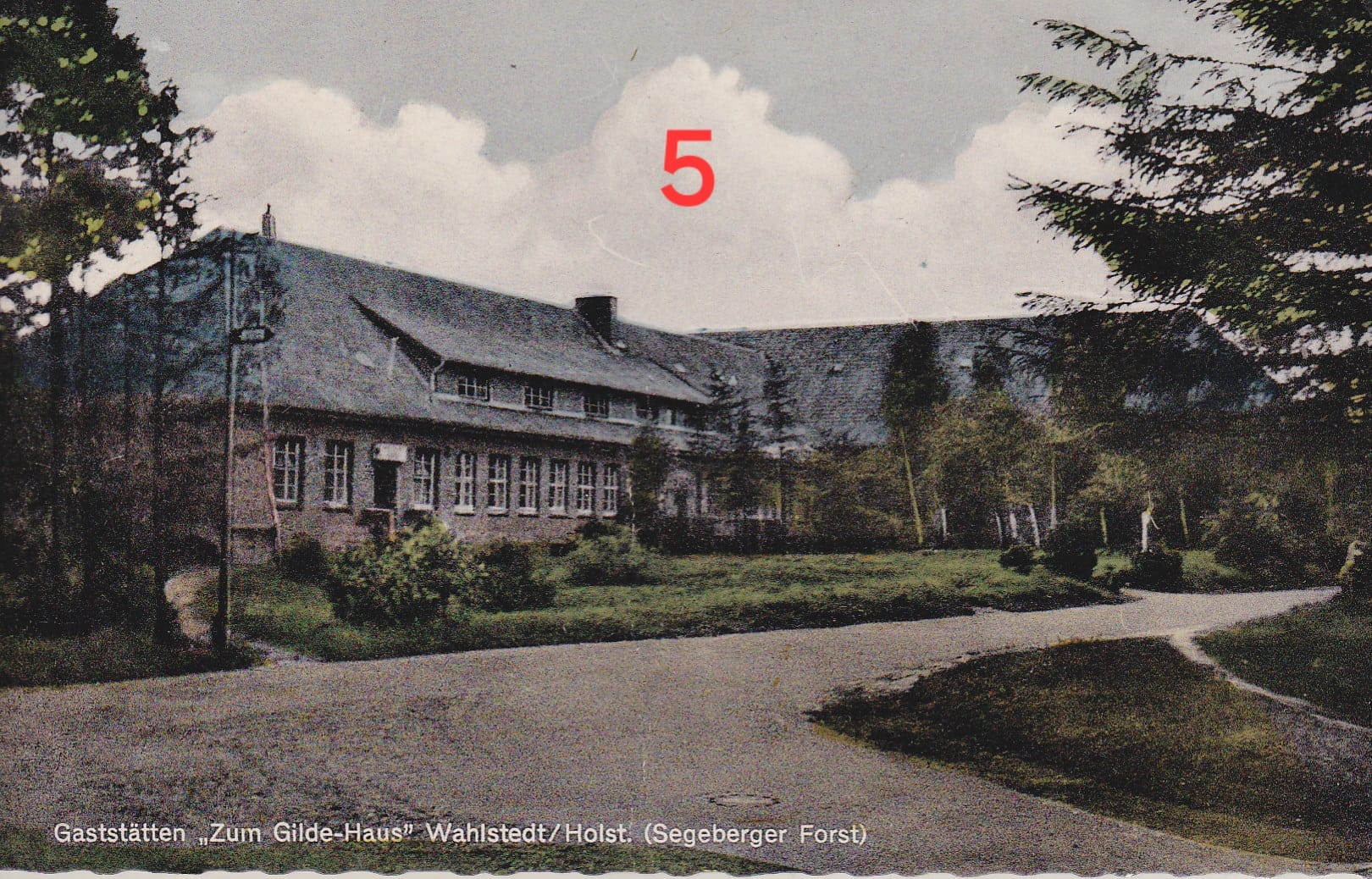
The farm building, measuring 1.625 square meters, had two dining halls, two dining rooms,
two kitchens, three cloakrooms, one sales room, one food distribution room, one pantry, and one
reading room. The attic contained nine living rooms, a toilet, and a shower. The
basement had one storage room and one cold storage room, as well as two air-raid shelters for 76 people.
Use of the buildings from 1945 onwards
After the war, the farm building was also used by the occupying forces to supply the troops and officers. From 1947 to 1954, it housed retraining workshops for construction workers run by the state employment office.
From 1955, it was then used as the “Wahlstedter Gilde,” the cultural center of the municipality of Wahlstedt, before being sold in 1960 as part of privatization to the Artur A. Erhoff company,
which manufactured women's fashion known throughout Europe under the label “erle zu” (petite woman) until September 1975.
After that, the Holstein-Kristallerie company sold a wide range of glasses and glassware there until March 2001, employing its own glassblowers and engravers. From 1988 to 1998, the rear of the building also housed the Lenhardt company's bicycle and automotive accessories shop, as well as its automotive workshop and car wash station.
After the property was sold to a textile company in 1998 and partially leased to the Baptist Brethren Church in 2001, the latter acquired the entire property in the summer of 2014 and subsequently renovated it step by step.
It is still used as a house of prayer today.
The semi-detached houses in the naval settlement, which were inhabited by former arsenal employees,
were confiscated by the military government from July 1945 to August 1946 in order to be made available to a Polish volunteer unit.
After that, the apartments and semi-detached houses could be rented and purchased by anyone.
Some of the barracks camps remained in use until the early 1960s, serving as makeshift living quarters.
Current status 2025
Evangelical Brethren Baptist Church, Dr.-Hermann-Lindrath-Straße 18, Wahlstedt