


6. Ammunition Repair
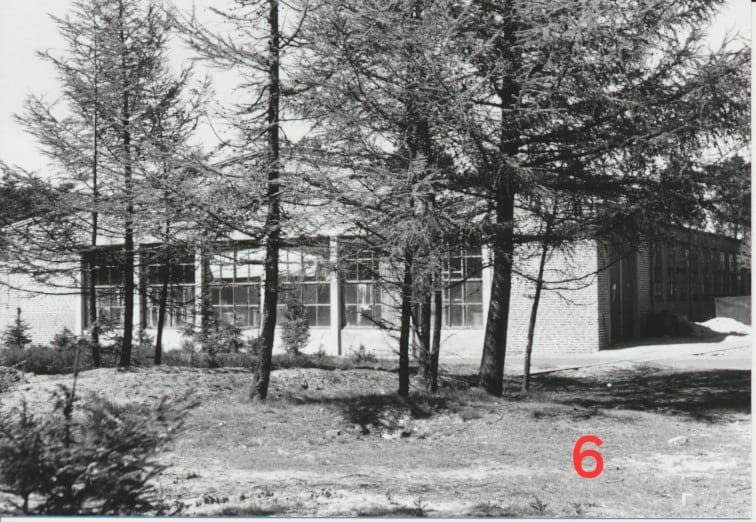
Ammunition repair
Use of the buildings 1939–1945
The tasks of ammunition repair included:
1. the inspection of own ammunition and foreign ammunition
2. the restoration of empty casings in two casing workshops and an associated electroplating plant
The two ammunition inspection buildings were located on what is now Kronsheider Straße, and their main task was to inspect ammunition returning from the front, namely: fuses, ignition charges, hand and machine weapon ammunition, close combat weapons, and signal ammunition.
All other ammunition was inspected from time to time between ongoing new production runs.
For the restoration of empty cartridge cases, with a daily working time of 8 hours, the daily capacity
of the large cartridge case workshop (located on the site of today's glassworks as Hall 13) was 5,400 8.8 cm cartridge cases, 800 12.7 to 20.3 cm cartridge shells and 160 21 to 40.6 cm cartridge shells
- and the small shell workshop (located on what is now the Arko site) at 11,000 2 cm cartridge shells and 6,500 3.7 cm cartridge shells
- as well as the electroplating capacity for zinc coating of 19,750 square meters of cartridge case surface area per day.
Next to the workshops were the corresponding (small and large) cartridge case storage areas. There was also a storage area for the uncleaned cartridge cases.
For the wastewater, some of which was chemically contaminated, there was a mechanical sewage treatment plant with biological post-treatment and two seepage fields as well as a detoxification plant.
1945–1947 Demilitarization and arsenal dissolution
Use from 1947 Tenants and owners
As early as 1947, the newly founded Norddeutsche Hohlglasindustrie Hermann Bulle GmbH began operations in the large sleeve workshop with the production of pressed glass, household glassware, and commercial glassware. The following arsenal buildings were subsequently added to the operation: large sleeve storage, galvanization, bathhouse, locomotive shed, powder cutter, demolding, compressor plant, 10.5 cm ammunition production building.
In 1956, the business was sold to Hans Herfried Tüxen, and subsequent owners were Nienburger Glas and Rexam.
In Wahlstedt, only white glass is produced for the beverage and food industries.
The small shell workshop and small shell warehouse are part of the Arko company premises
(see panel 8).
While one of the two ammunition inspection buildings fell victim to the expansion of the Okal model house center, the other building was taken over in 1954 by by Rosemarie Floss, who acquired it in 1960 and added a large extension.
Her business manufactured jersey women's outerwear, suits, loungewear, coats, and women's underwear.
The business was taken over by Marlies Rautmann, who sold women's fashion and accessories in the “Jerseykeller,” a part of the building complex, while in another part, the Teegen und Glage company set up and still operates a car repair and trading business.
In the meantime, the property has been sold, the annex renovated, and its
upper floor continues to be rented by the dance division, while the basement can be
rented as an event space and there is a bar in the former Jerseykeller.
Current status 2025
- Teegen/Glage, car repair and dealership
- Kuddel's Inn
- IK Event Location