


8. Ammunition Production Areas
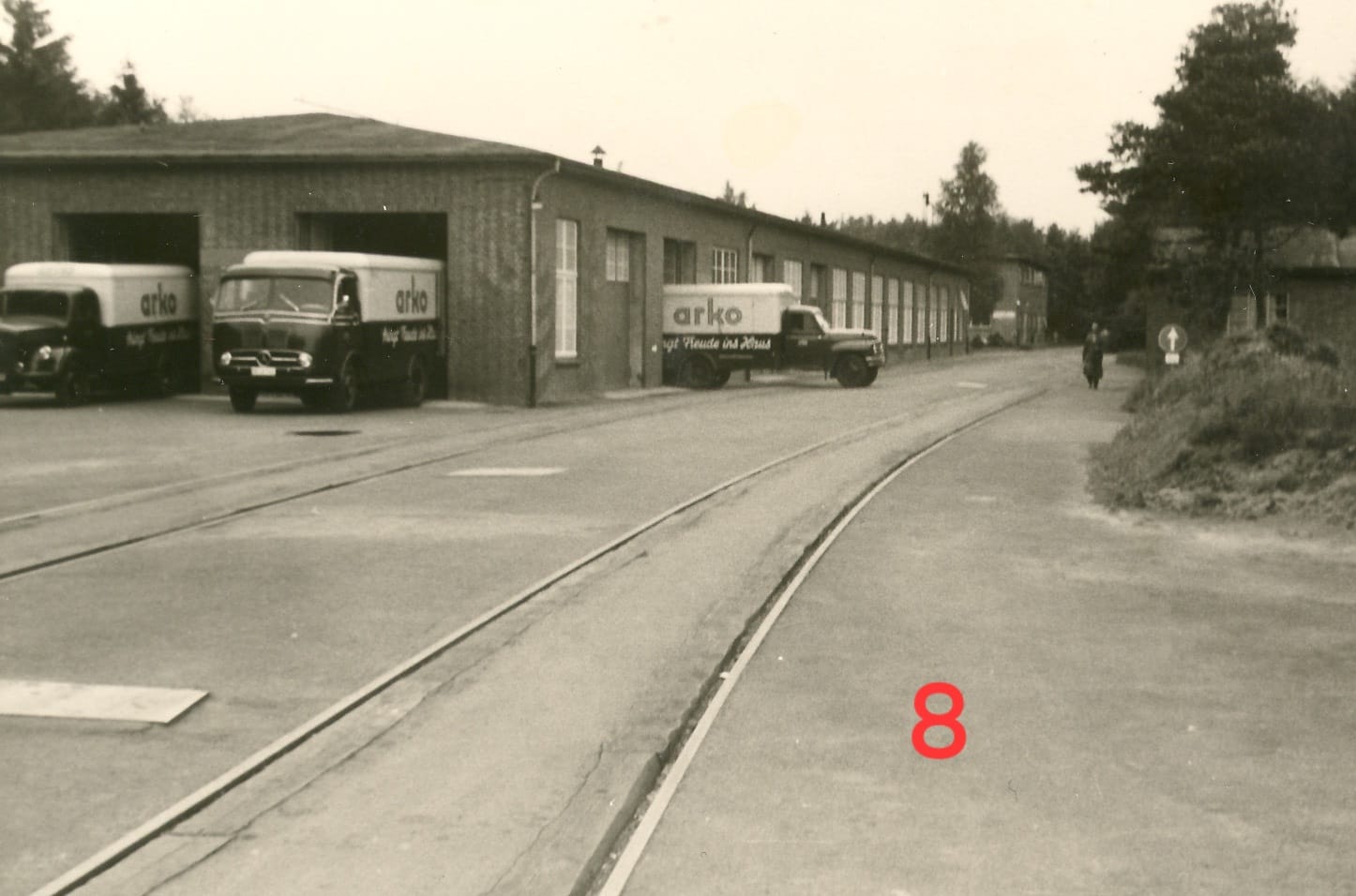
The ammunition production areas
The ammunition production facilities constituted the most important part of the arsenal.
All of these buildings had been constructed in accordance with the latest state of the art and
safety regulations for ammunition factories and were equipped with the
most modern production machinery. This complex comprised 13 halls. Each building was used to manufacture only one product, which also gave it its name.
The following list of production buildings shows their names, the average number of employees, and the respective production capacity per working day, based on an 8-hour working day:
1. 2.0 cm building / 40 workers / 16,000 2.0 cm cartridges
2. I. 3.7 cm building / 70 workers / 6,000 3.7 cm cartridges
3. II. 3.7 cm building / 70 workers / 6,000 3.7 cm cartridges
4. I. 8.8 cm building / 75 workers / 2,000 8.8 cm shells
5. II. 8.8 cm building / 75 workers / 2,000 8.8 cm shells
6. 10.5 cm building / 75 workers / 1,800 10.5 cm or 2,000 8.8 cm cartridges
7. I. Cartridge Hall / 45 workers / from 2,000 12.7 cm cartridge cases to 200 38.0 cm pre-cartridges
8. II. Cartridge Hall / 45 workers / capacity as before
9. I. Projectile Production Hall / 25 workers / from 1,000 12.7 cm projectiles to 80 38.0 cm projectiles
10. II. Projectile production hall / 25 workers / capacity as before
This area also included the sewing room, where around 50 women used
40 electric sewing machines to produce all the cartridge bags.
1945–1947 Demilitarization and arsenal dissolution
Use from 1947 Tenants and owners in succession
The 2.0 cm and the two 3.7 cm buildings, together with the wash and
changing room, the special consumables warehouse, one of the two electrical workshops
and the small sleeve workshop and warehouse, became part of the company premises of arko GmbH, founded in 1948 by Cuno Rothfos. Over time, arko developed from a coffee roastery with its own distribution system, through an initial expansion of production with its own candy and spirits production and wine cellar, into a chain of stores for luxury foods that was widespread in northern Germany.
Despite extensive restructuring and a new main shareholder, it was not possible to adequately
counteract the changed market conditions. In 2024, the company had to file for bankruptcy.
The confectionery manufacturer Viba Sweet GmbH took over the trademark rights and 125 of the arko, Hussel, and Eilles stores through asset deals.
The previously vacant property has apparently found a new (partial?) user in the form of MechTech GmbH from Bargteheide.
The two 8.8 cm buildings were the first two production buildings of W.Pelz GmbH & Co. KG, founded in 1948, and thus form the historical core of the Wahlstedt-based Pelz Group.
While the 10.5 cm building became part of the glassworks, the Bierbaum company, which moved from Chemnitz to Wahlstedt in 1946 and initially operated in Waldesruh, moved into the two-story production halls in 1948 under the name Edelform-textil to produce high-end women's underwear.
The company existed until 1963. Since then, the buildings have been used by
Pely-Tex GmbH & Co. KG, a company belonging to the Pelz Group that produces nonwoven fabrics.
In 1957, the letterpress printing company F.K. Koch moved into the I. Kartusch Hall, which then became the printing and publishing company Wahlstedter/Segeberger Anzeiger in 1983.
After that, the SB-Schwingungstechnik Broneske GmbH company used the property, and since 2013, the
"plant engineering and contract manufacturing, distribution of control technology and
production machines."
Finally, the second Kartusch Hall was used by the Ehmke carpentry workshop from 1952 onwards.
In 1996, Mr. and Mrs. Schirmacher took over the business and expanded it into a manufacturing carpentry workshop.
In 1948, the company “Lichenheldt KG-Chemisch Pharmazeutische Fabrik” moved into the sewing room,
initially focusing in particular on the manufacture of “family panaceas” such as ointments/balms, stomach drops, lemon balm spirit, etc.
After the Eisele family took over the business in 1984 and built a second production facility at Industriestraße 7-9, the company is now a contract manufacturer of pharmaceuticals and health products.
Current 2025
- MechTech GmbH (?)
- W. Pelz GmbH & Co. KG, Willy-Pelz-Str. 8-9, Wahlstedt
- Ardagh Glas GmbH, Dr.-Hermann-Lindrath-Str. 21, Wahlstedt
- Pely-tex GmbH & Co. KG, Willy-Pelz-Str. 2-4, Wahlstedt
- Item, Technologies & Machine, Gutenbergweg 3, Wahlstedt
- Manufakturtischlerei EHMKE GmbH & Co. KG, Willy-Pelz-Str. 6, Wahlstedt